Hand block printing process: the steps from plain cloth to finished print
Hand block printing has five broad stages: preparing the cloth, printing the outline, filling the colours, fixing the dye, and the final wash. The stamping that people picture is only the middle part.
First the plain cloth is washed to remove starch and oils, so that colour can enter the fibre, and then dried. It is stretched and pinned on a long padded table. The printer begins with the outline block, called rekh in Rajasthan, which lays down the fine lines of the design. Filler blocks, known as datta, and background blocks, known as gadh, follow one colour at a time.
After printing, the cloth is dried in the open. Depending on the dyes, the colour is then fixed by steaming, sunning or other treatment, and the cloth is washed again to remove loose dye and gum. Methods differ from one workshop to the next, and a single piece can take several days.
Sanganeri vs Bagru print: what is the difference?
Sanganeri prints are known for fine, delicate flowers on a white or pale ground, while Bagru prints are known for bolder motifs in earthy colours on a cream or dyed ground. Both come from towns near Jaipur.
In the Sanganer style, small buds, sprays and leaves are printed with thin outlines in many colours. The background is kept light, so the cloth looks fresh and airy. In the Bagru style, the colours are traditionally deep red, black and brown shades, and the cloth is often given a cream base before printing.
On bedding, a Sanganeri-style sheet tends to look light and bright, and a Bagru-style one looks warm and rustic. Today both names are also used loosely for the look alone, including on screen-printed cloth. If the method matters to you, see whether the product's details say the piece is printed by hand.
What is dabu printing?
Dabu is a resist method of block printing, in which a paste is stamped on the cloth to block the dye, so the covered parts stay undyed. The pattern appears where the colour could not reach.
The paste is traditionally made with clay and other natural materials. It is pressed on with a wooden block, and sawdust is sprinkled over it so that it dries without smudging. The cloth is then dipped in dye, very often indigo, the deep blue. After drying, the paste is washed off, and the design shows in the colour of the cloth beneath.
The steps can be repeated to build two or three shades. Dabu prints have a soft, slightly cracked look, because the dried paste breaks in places and lets thin veins of dye through. These lines are part of the style. Indigo dabu bedding may release some blue in early washes, so wash it separately at first.
Buti, bel and jaal: common motifs in block print bedsheets
Most block print designs are built from three kinds of motif: the buti, the bel and the jaal. Knowing these words makes product descriptions easier to follow.
A buti is a small single motif, such as a flower, leaf or mango shape, repeated at even gaps across the cloth. A larger one is called a buta. A bel is a running border, a creeper of leaves and flowers printed along the edges. A jaal is an all-over network in which the motifs are joined by stems or lines, so the whole surface is covered.
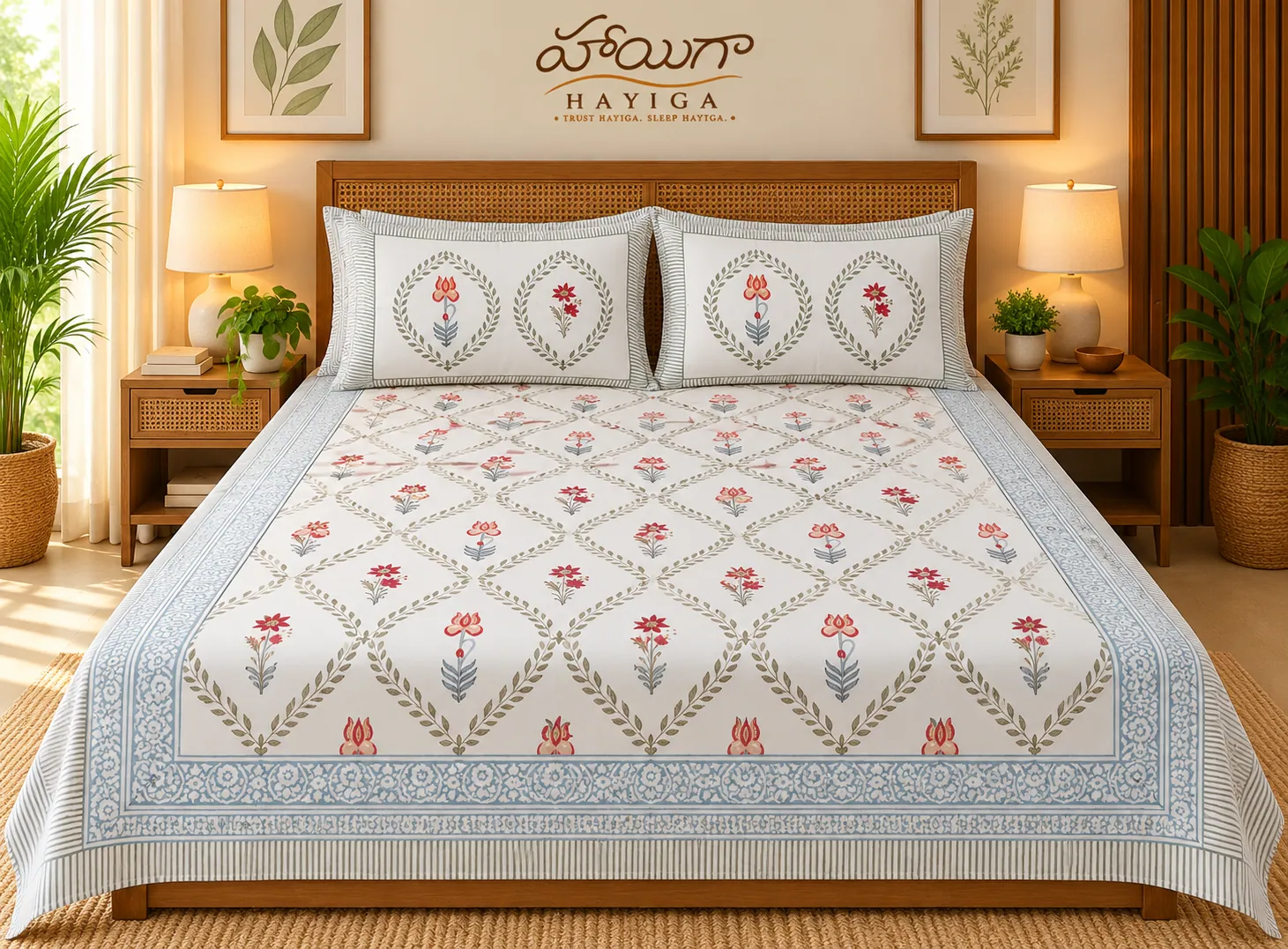
A typical block print bedsheet has a field of butis or a jaal in the centre and one or more bels around it. The border is printed with separate blocks, and its corners are where a printer's skill shows, since the pattern has to turn neatly. Small butis look calm in a small room. A dense jaal hides creases and daily wear better.
How are the wooden blocks for printing carved?
Printing blocks are carved by hand from seasoned hardwood, with the design standing out in relief on the flat face. Carving is a separate skill from printing, and is usually done by different craftsmen.
Woods such as sheesham and teak are commonly used, because they are dense and hold fine detail. The surface is planed smooth, the design is traced on it, and the carver cuts away the background with small chisels and a hand drill. What remains raised is what will touch the cloth. A set for one design includes one block for each colour, cut to fit together exactly.
Many blocks have small holes drilled through them. These let air escape when the block is pressed, so the colour lies evenly. New blocks are usually soaked in oil for some days before use, to stop the wood from cracking. A well-kept block can print for years, though fine edges slowly wear.
Hand block print vs digital print: how do they look on bedding?
A hand block print has a soft, slightly uneven look with a limited set of colours, while a digital print can show sharp, photo-like detail in any number of shades. Neither is a fault. They are different methods.
Digital printing sprays ink on the cloth from a machine, guided by a computer file. It can reproduce shading, large pictures and tiny details that no carved block could manage. Every repeat is identical. Hand block designs are built from flat areas of colour, one block at a time, so they look simpler and bolder.
Turn the cloth over to compare. In many block prints the dye soaks in well and shows clearly on the back. In surface prints the back stays much paler. This is a hint, not proof. Designs that copy the block print look are common, so if hand work is important to you, rely on what is stated in the product's details.
Is hand block printing done only on cotton?
No, hand block printing is done on several fabrics, but cotton is by far the most common for bedding. Cotton is absorbent, lies flat on the printing table and takes dye evenly.
Fine cottons such as mulmul and voile are used for dohars, quilts and light sheets, and denser cotton for everyday bedsheets. Silk, and blends of cotton with silk or linen, are also block printed, mostly for saris, stoles and dress material. On smooth, slippery cloth the printer has to work more slowly, because the block can slide and the colour can spread.
The base cloth changes the look of the same block. On thin mulmul the print appears soft and slightly see-through. On thick cotton it looks solid and crisp. For bedding, note the fabric named in the product's details together with the print, since the cloth decides how the sheet feels and washes, and the print decides only how it looks.