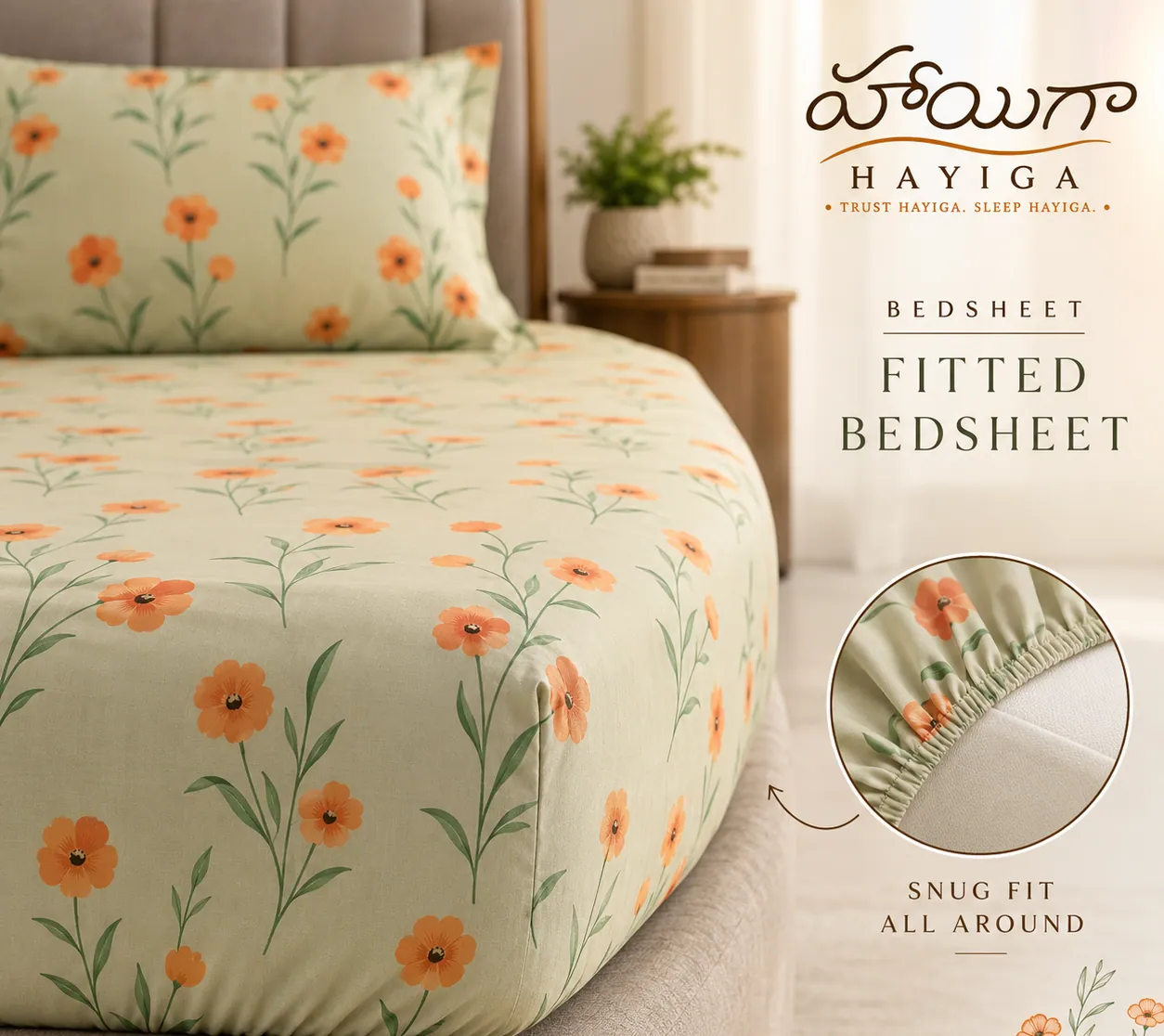
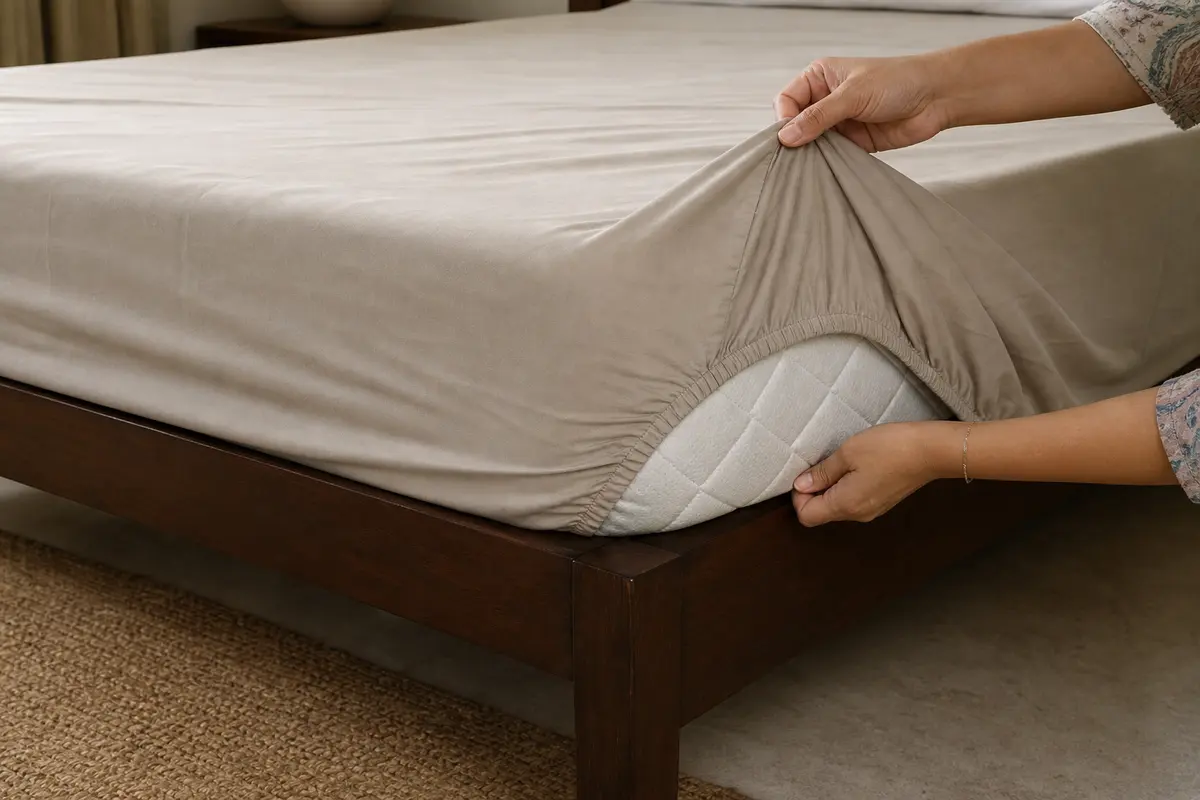
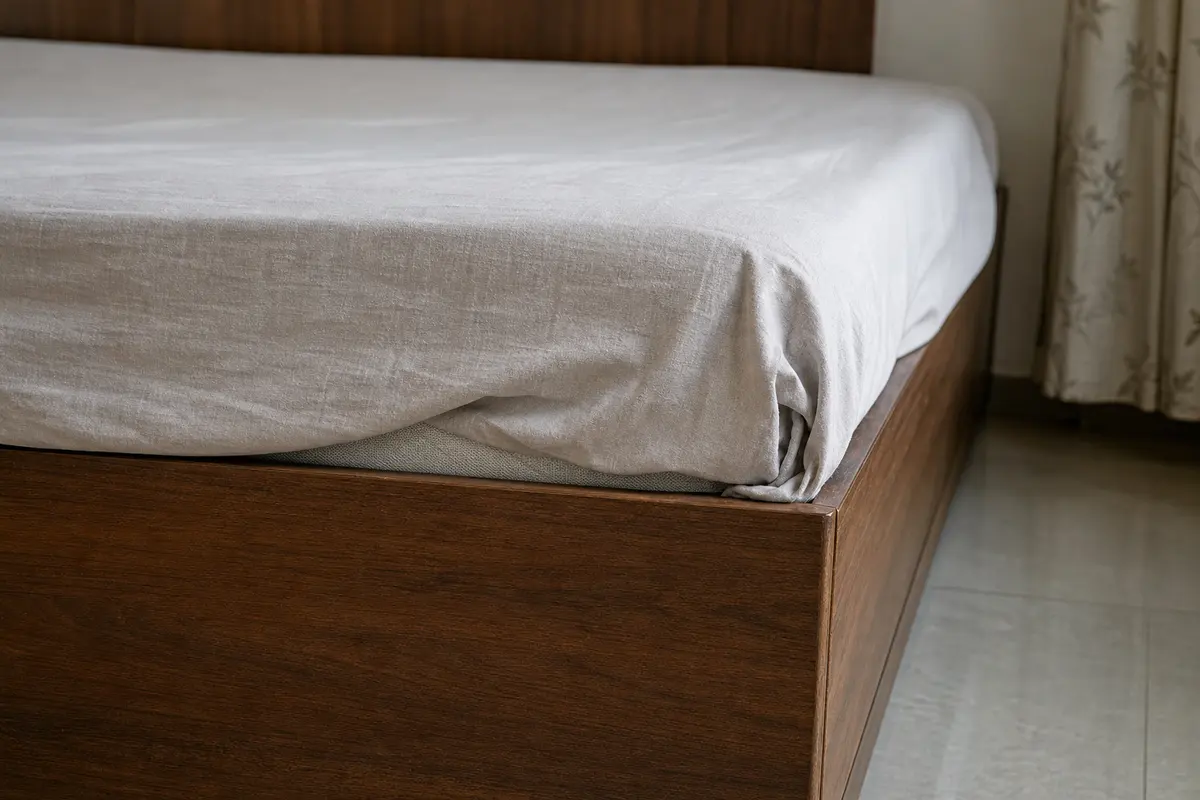
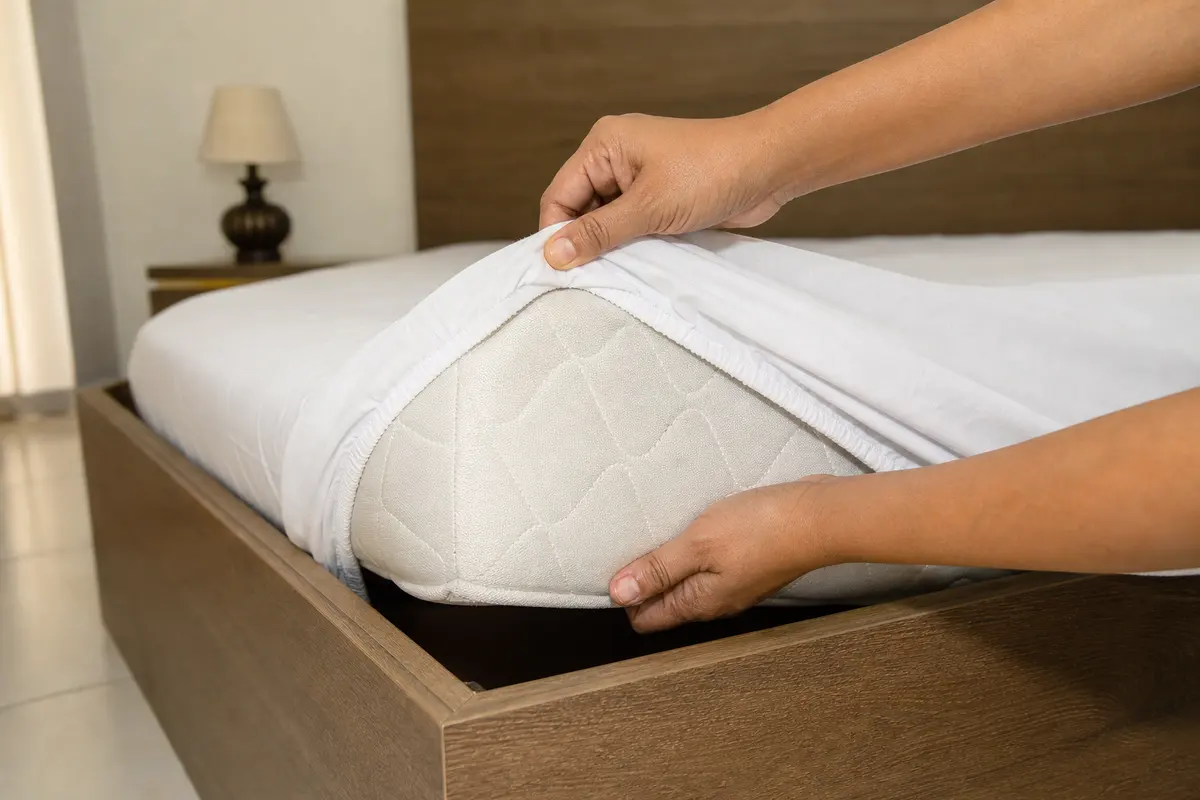
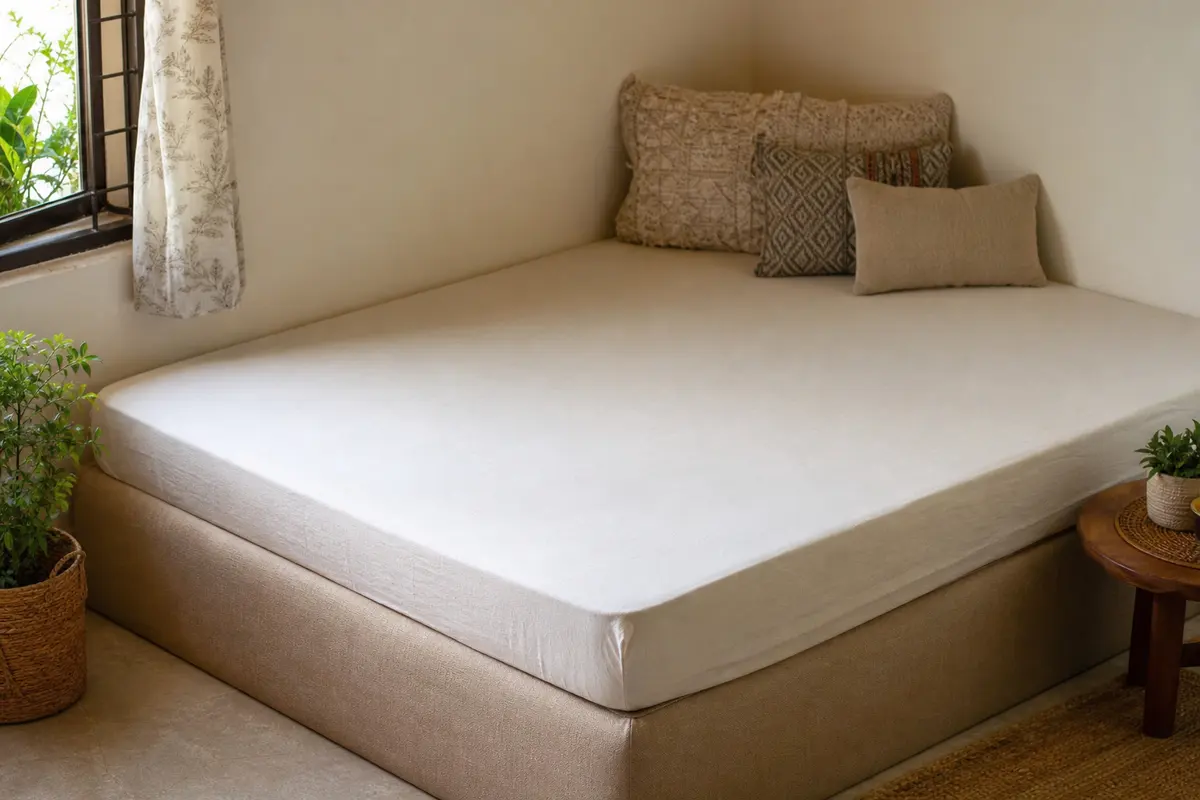
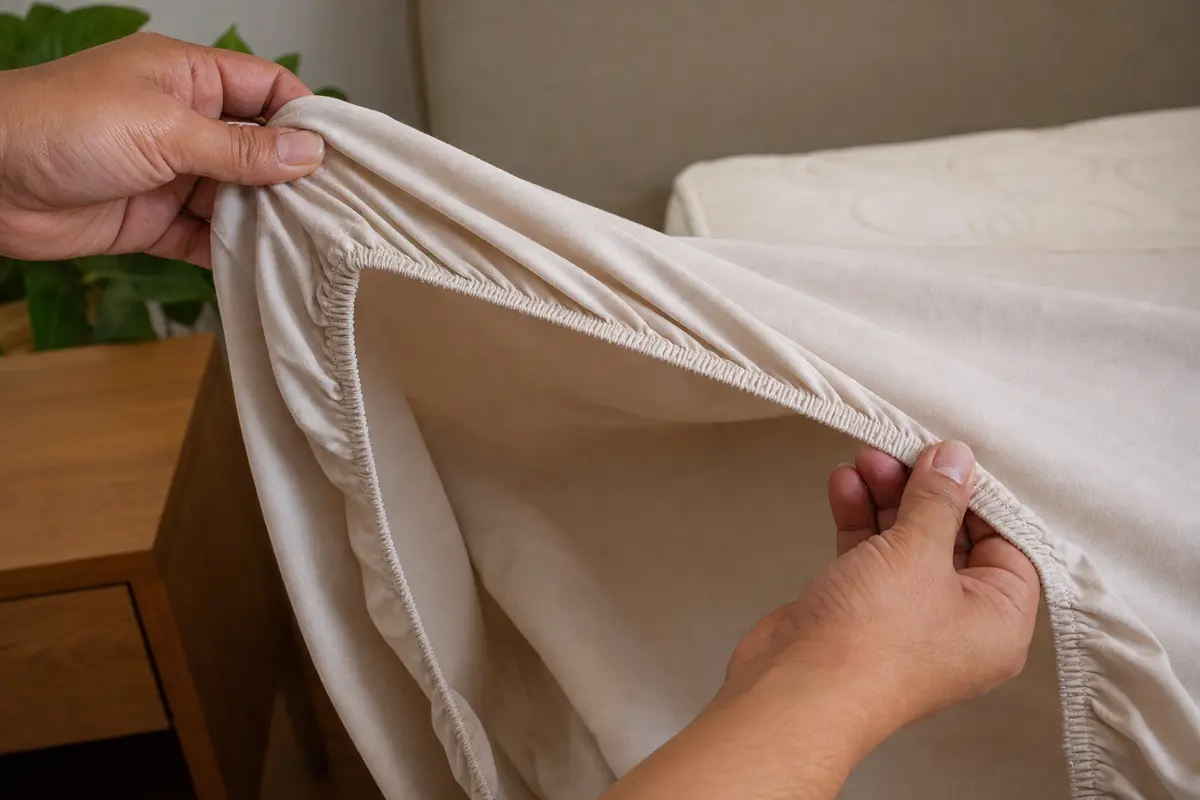
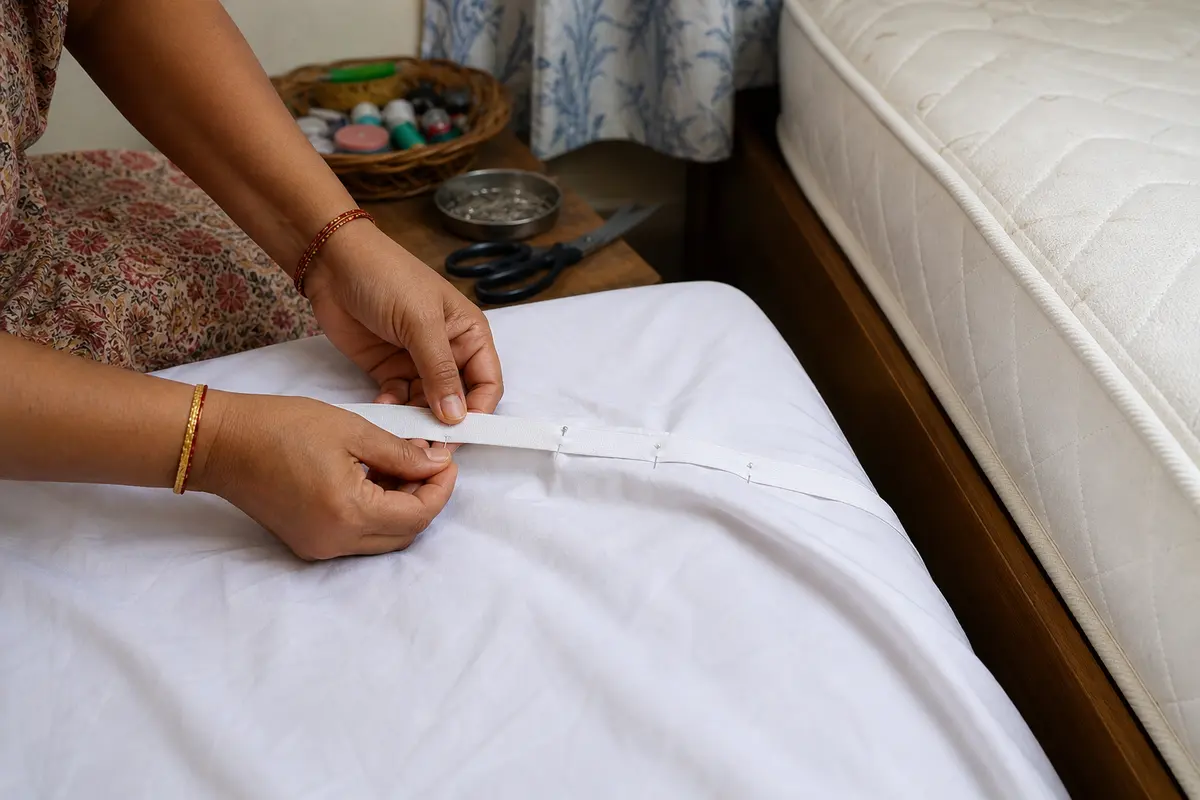
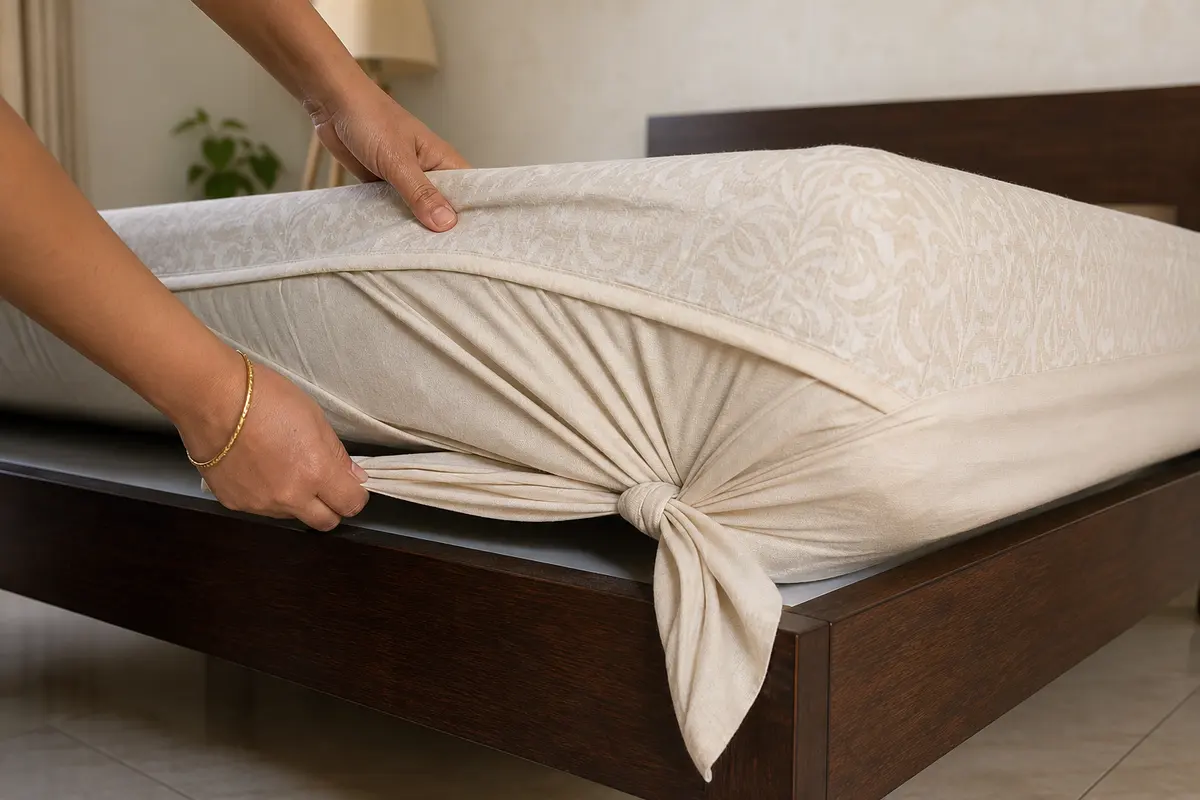
Elastic edges that hold the sheet on the mattress.
01The short answer
A fitted bedsheet is a bedsheet with elastic sewn into its corners or all around its edge, so it grips the mattress and stays in place without tucking. You pull it over the mattress like a cover, one corner at a time. Because it holds tight, it does not come loose or bunch up easily when you turn in your sleep. The catch is that a fitted sheet is made for one mattress size and one range of mattress height. So you must measure your mattress, including its height, before choosing one.
02Fitted bedsheet: all you need to know
Which fitted bedsheet depth suits a 6 inch or 8 inch mattress?
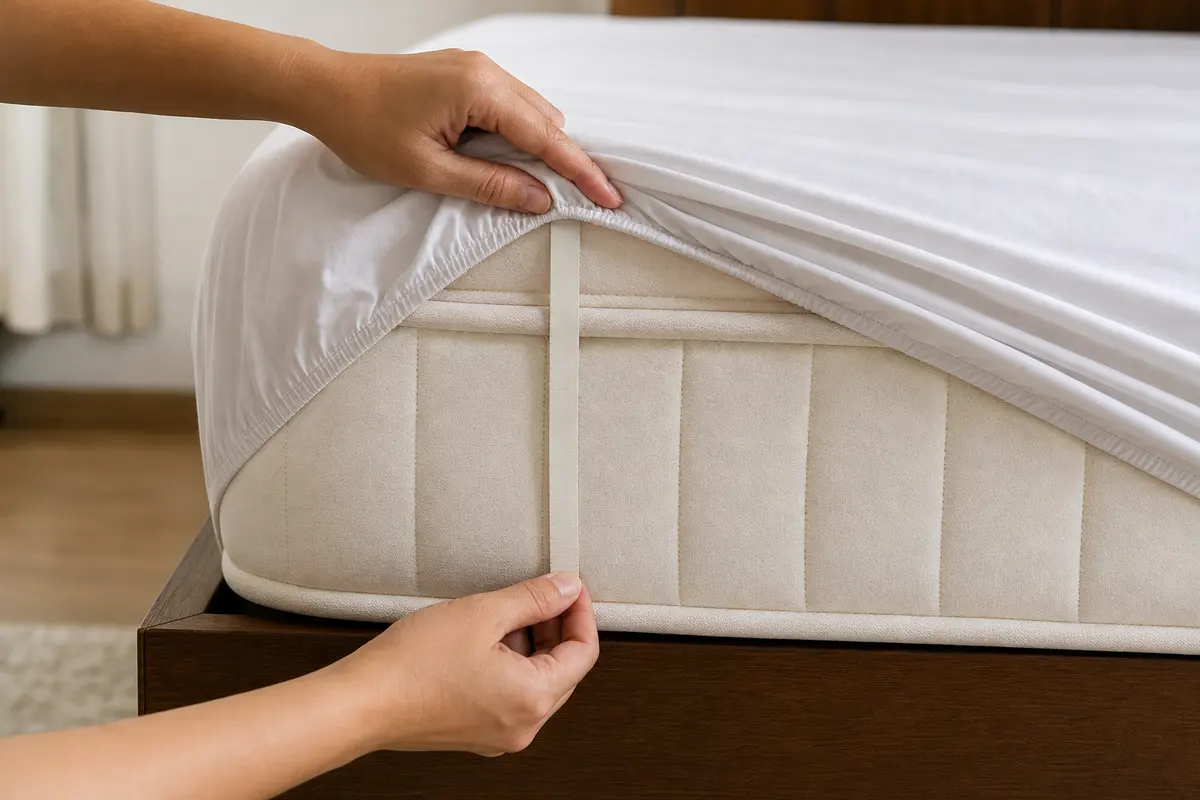
Choose a fitted bedsheet whose stated depth is a little more than the height of your mattress, so the elastic can turn under the bottom edge. A sheet whose depth only equals the mattress height has nothing left to grip with.
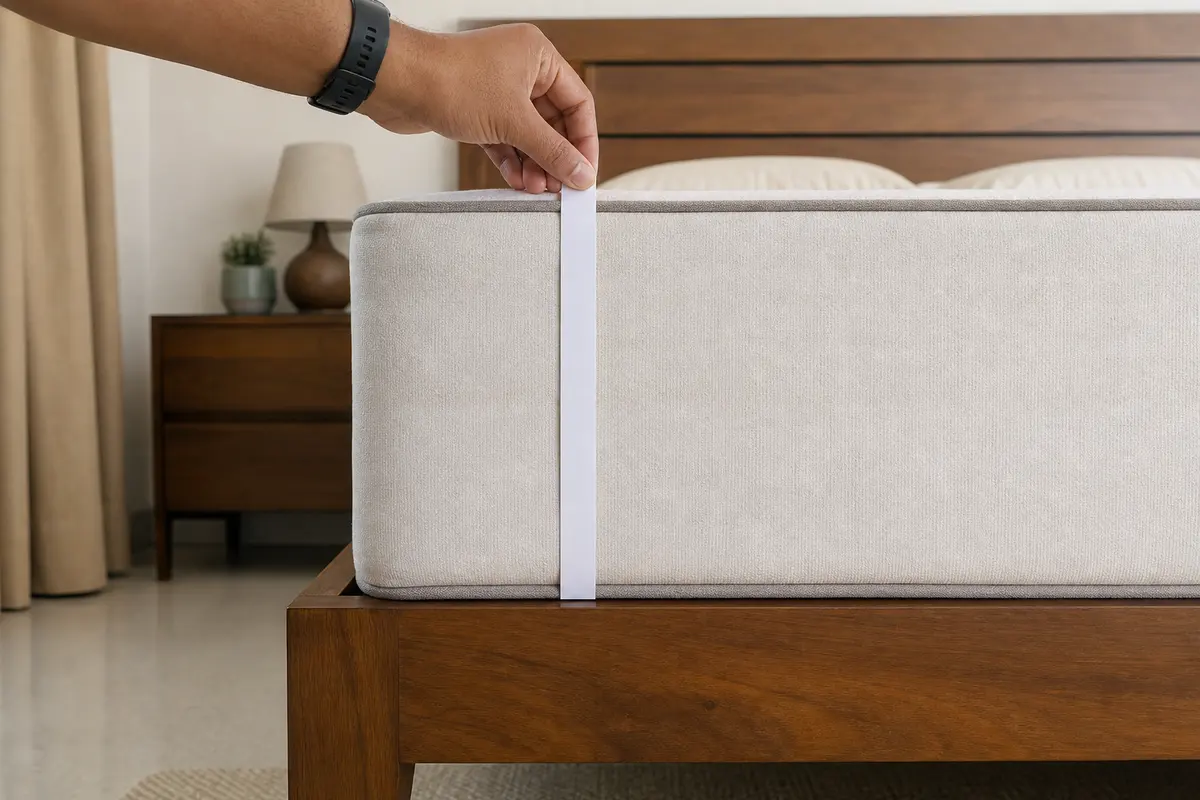
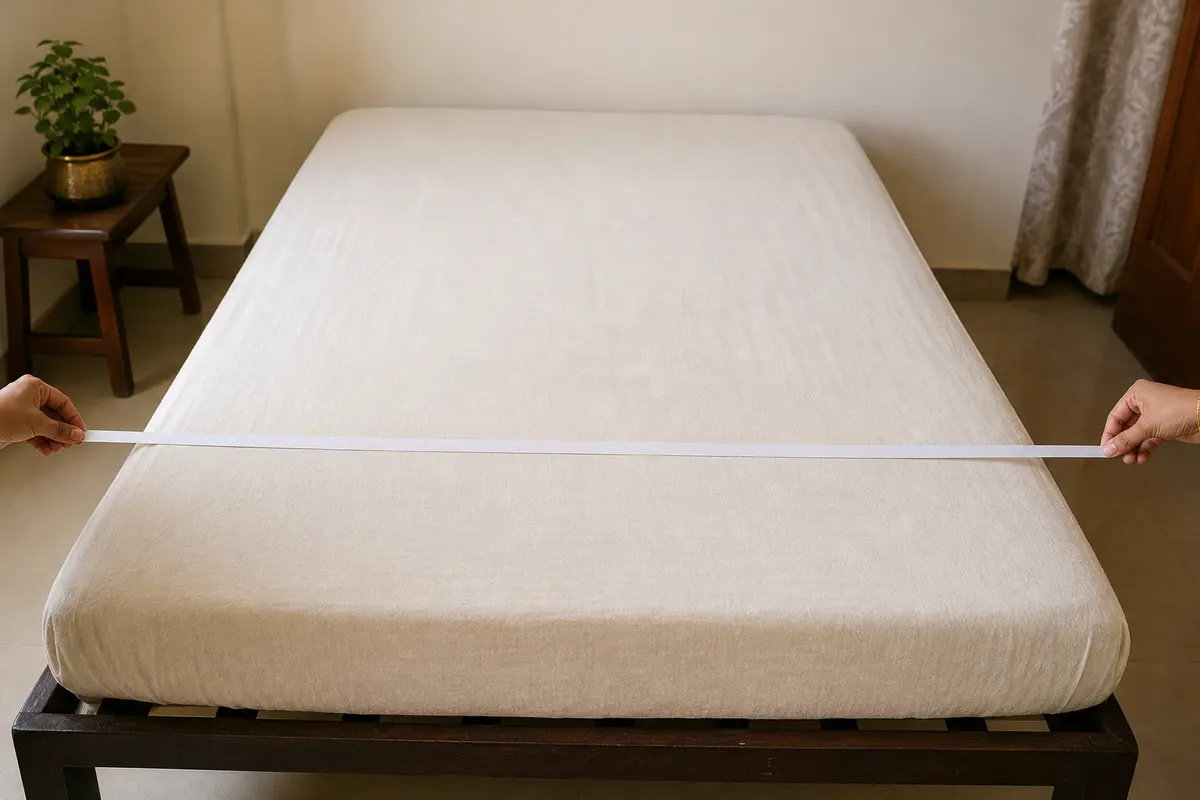
Measure the side of the mattress from the bottom seam to the top seam with a tape. Indian mattresses are commonly 4, 5, 6 or 8 inches high, and some spring or pillow-top ones are 10 inches or more. As a rough guide, an inch or two of extra depth is enough for the elastic to hold. If you use a topper or a thick mattress protector, add its height as well.
Makers describe depth in different ways. Some write that the sheet fits a mattress up to 8 inches. Others give the pocket measurement itself. Read the wording in the product's details carefully, and when in doubt compare it with your own tape measurement.
Fitted bedsheet for king size and queen size beds: what to measure
For a king or queen bed, the length and width of the fitted sheet should match the top of your mattress almost exactly. Unlike a flat sheet, extra cloth is not helpful here. It only makes wrinkles.
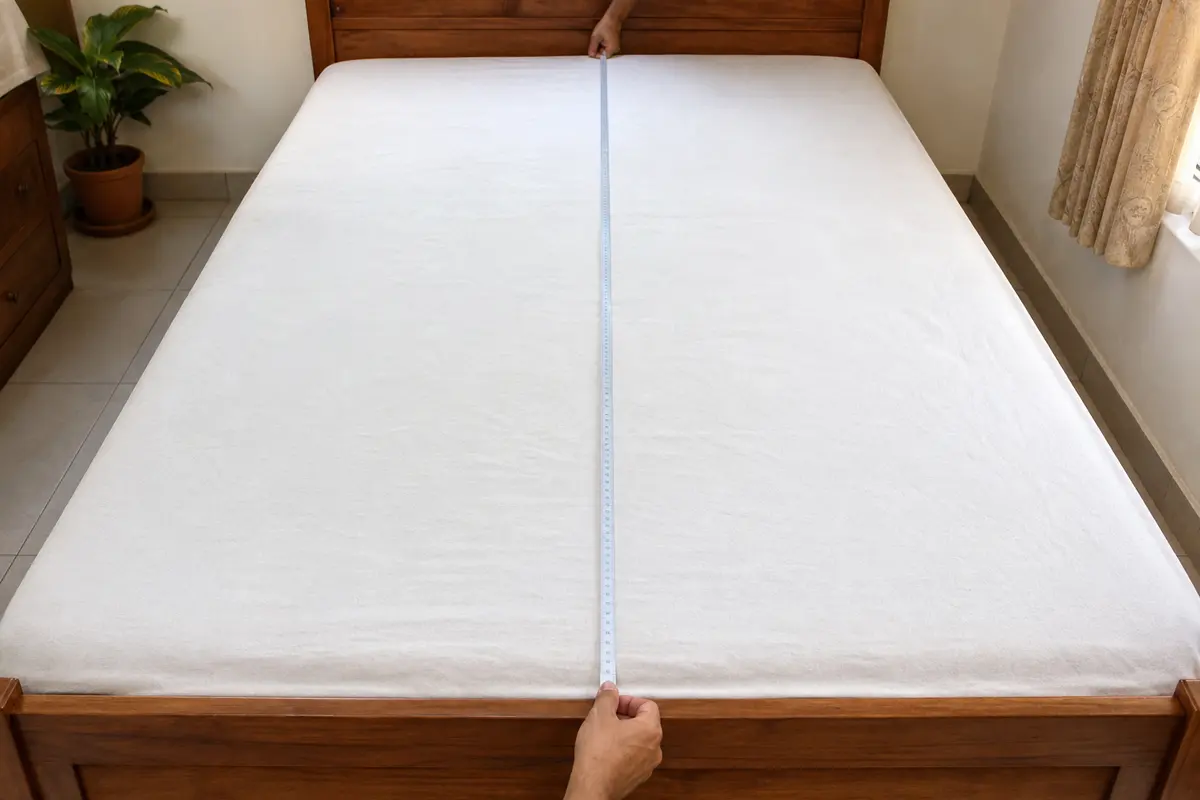
Usual Indian mattress tops are about 72 inches wide for a king and 60 inches wide for a queen, with lengths of 72, 75 or 78 inches. The length is where people slip up. A sheet cut for a 72 inch long mattress will be tight on a 78 inch one and may pull off at the head end.
So write down three numbers before you shop: width, length and height. Then look for the same three in the listing. Size names alone are not enough, because one maker's king may be another maker's queen. If your mattress was made to order for an old cot or a custom bed, the measurements matter even more.
Are fitted sheets a good idea for storage beds and box beds?
Yes, fitted sheets suit storage beds well, because on these beds the mattress often sits inside a raised wooden frame and there is little room to tuck a flat sheet.
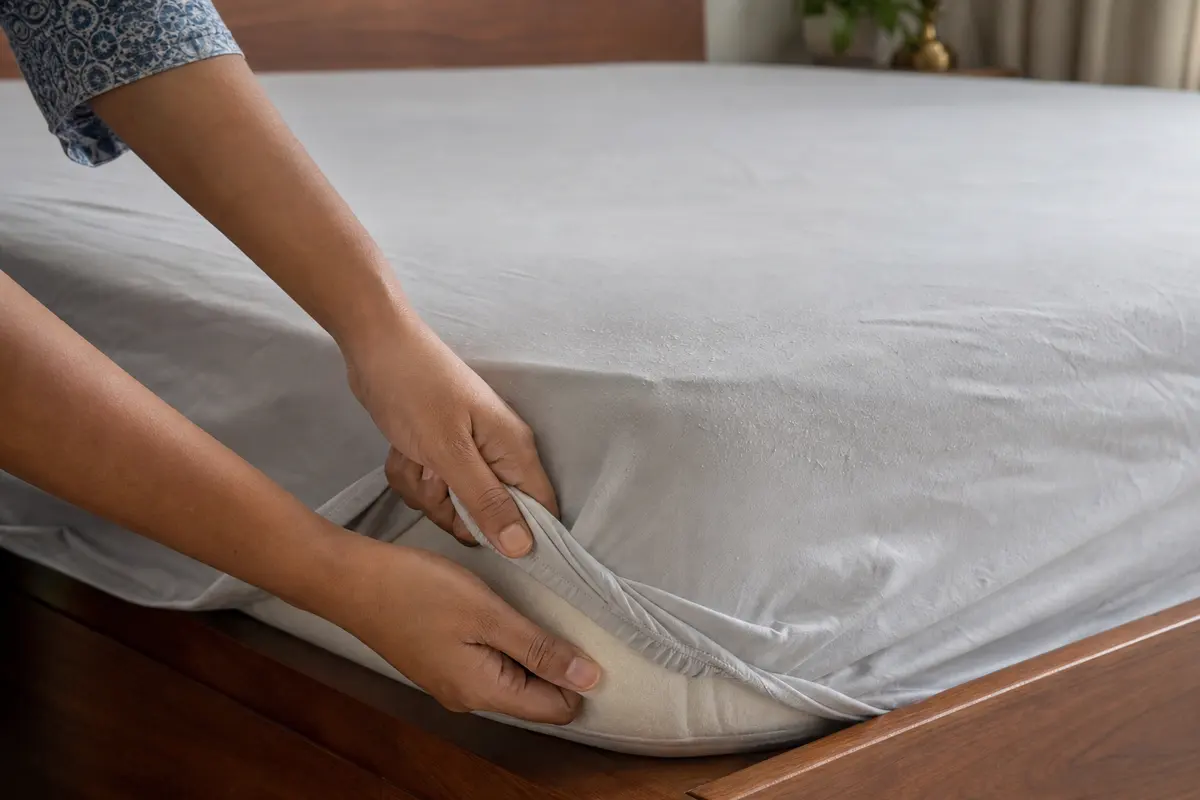
On a hydraulic or box bed, the gap between mattress and frame may be only a finger wide. Pushing a flat sheet into that gap every morning is slow, and the sheet rides up by night. A fitted sheet needs only its four corners pulled over the mattress. You lift each corner a few inches, slip the pocket on, and the frame hides the elastic edge.
The same is true for bunk beds, diwans against a wall and beds pushed into a corner, where you cannot walk around to tuck all sides. One caution: lifting a heavy mattress corner inside a tight frame takes some effort, so in such beds a sheet with slightly generous depth is easier to put on.
How is a fitted bedsheet with elastic stitched at the corners?
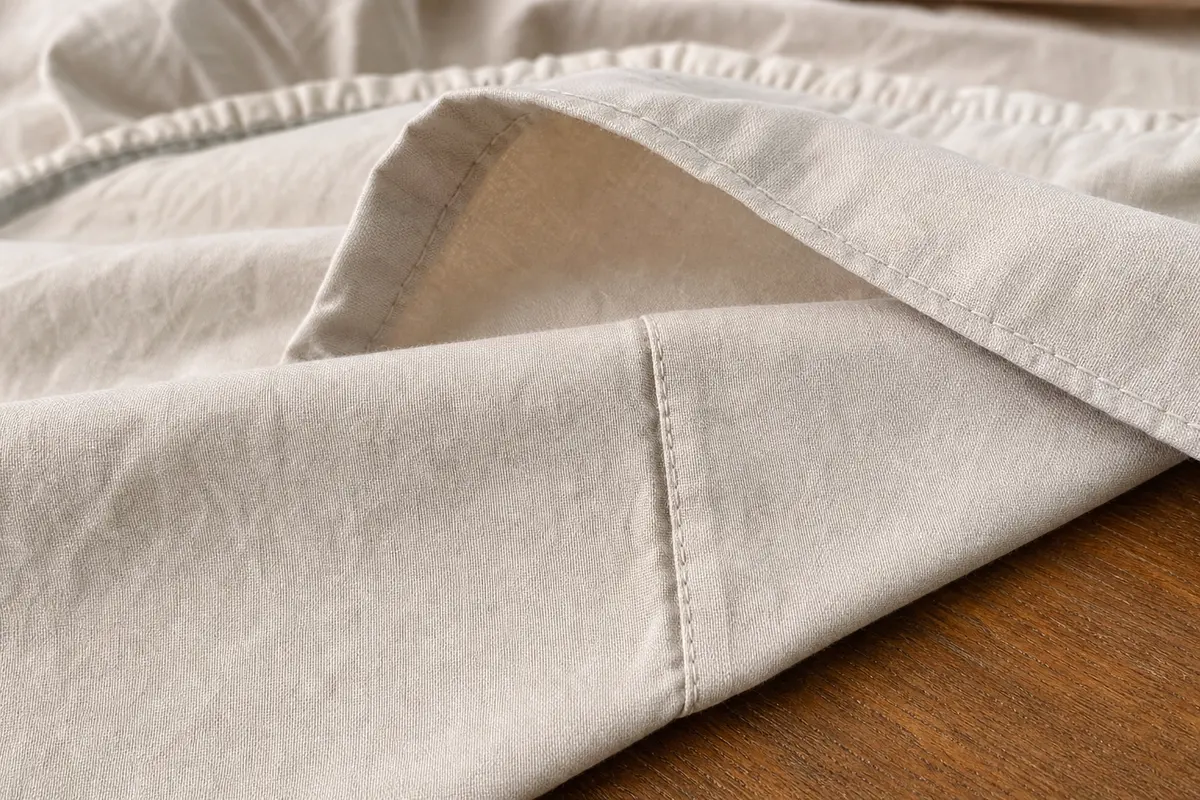
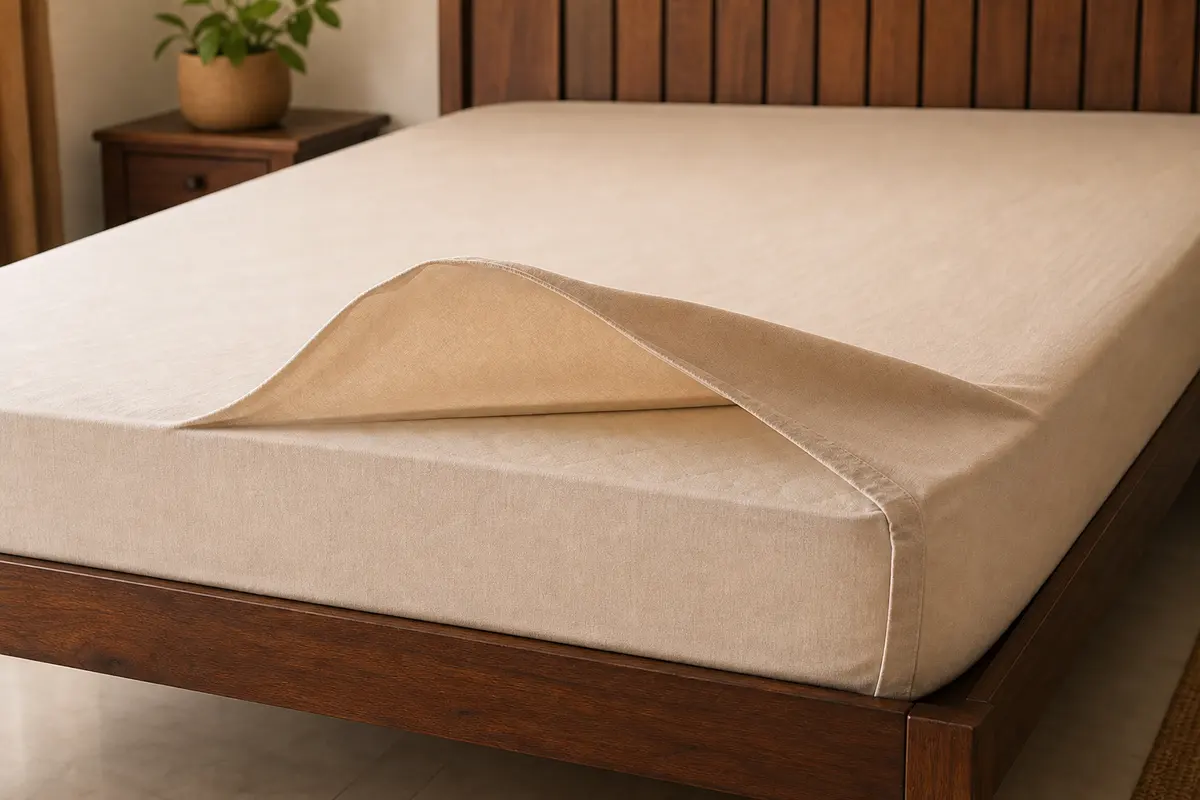
A fitted bedsheet gets its shape from four stitched corner seams that turn a flat cloth into a shallow box, and from elastic sewn into the hem. The seams decide the depth. The elastic decides the grip.
At each corner a square of cloth is cut away or folded, and the two edges are sewn together. This makes a pocket that sits over the mattress corner. A neat, straight seam with close stitches is a good sign, because the corners take the most pull every time the sheet goes on.
The elastic is then stitched inside a folded hem, called a casing, or sewn directly to the edge. Stretch a corner gently with your hands. The elastic should spring back and the stitching should not make a cracking sound. Some sheets also carry a small label on one side to show which is the length, which saves turning the sheet around.
Do fitted sheets shrink or wrinkle after washing?
Cotton fitted sheets can shrink a little in the first few washes, and they can wrinkle, but a snug fit on the mattress pulls most creases flat. How much a sheet shrinks varies by maker and fabric.
Shrinking matters more in a fitted sheet than in a flat one, because there is no spare cloth. Hot water and high heat add to it, so cool or lukewarm water is the safer choice unless the care label says otherwise. If a sheet feels tight after washing, put it on while it is very slightly damp and let it finish drying on the bed. The cloth relaxes as it is stretched.
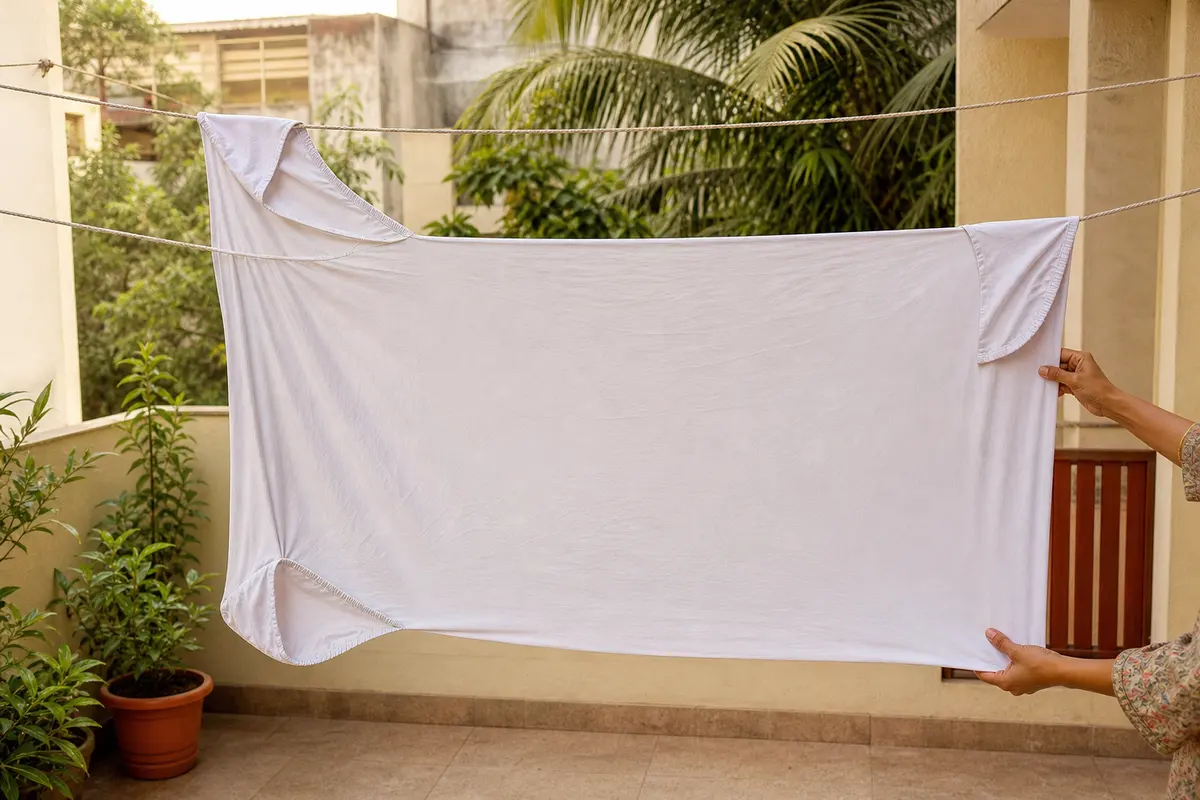
For wrinkles, shake the sheet out well before hanging, and dry it spread over two lines so the elastic edge does not bunch. Most people do not iron fitted sheets at all. If you want to, iron only the flat middle and leave the corners.
Can a flat bedsheet be made to hold like a fitted one?
Yes, a flat sheet can be made to hold more firmly with sheet clips, with corner knots, or by asking a tailor to add elastic. None of these is quite as neat as a true fitted sheet, but they help.
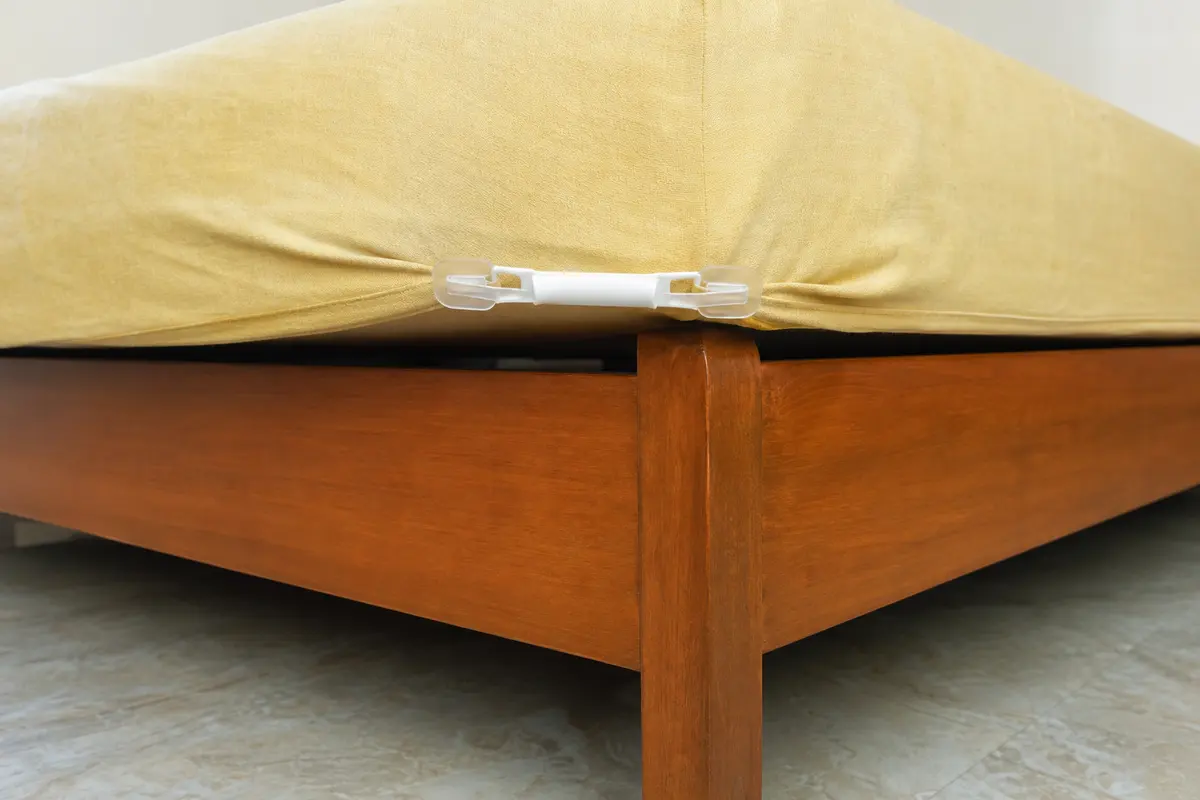
Sheet clips, also called sheet fasteners or suspenders, are short elastic straps with a grip at each end. They are fixed under each corner of the mattress and pull the sheet tight. They are handy if you already own good flat sheets.
A tailor can also stitch corner seams and elastic into a flat sheet. For this the sheet must be large enough. Its width and length should exceed the mattress top by roughly twice the mattress height, plus a few inches to turn under. Give the tailor all three mattress measurements. A quicker home method is to tie a loose knot in each corner of the sheet and tuck the knot under the mattress.
The pictures in this article are illustrations made to explain each point. They are not photographs of Hayiga products.
03When should you use it?
How it is made
It is a normal bedsheet fabric with stitched corner pockets and elastic. Some have elastic only at the four corners; others have it all around the edge, which usually grips better.
When to use it
Useful for children's beds, people who move a lot in their sleep, and anyone who does not want to tuck in and straighten the sheet every morning.
Mattress height matters
Each fitted sheet fits mattresses up to a certain height, sometimes called pocket depth. If your mattress is taller than that, the corners will keep popping off.
Benefits
The surface stays smooth and flat, the bed is quick to make, and the sheet does not hang down the sides. It looks neat on beds where the mattress sides are visible.
Limits
It fits only the size it is made for and cannot be used on a bigger or much smaller bed. It is harder to fold than a flat sheet, and the elastic can loosen over the years.
Care
Wash as the care label says. Very hot water and long hours in strong sun can make elastic lose its stretch sooner. Drying in shade or mild sun is kinder to it.
04Before you buy
✓Your mattress length and width against the sheet's measurements
✓Your mattress height, including any topper, against the depth the sheet can cover
✓Whether the elastic runs all around the edge or only at the corners
✓The fabric stated on the product
✓Whether pillow covers are included, and how many
✓The care instructions, since heat can affect elastic
✓Whether your bed is a standard size; an unusual size may suit a flat sheet better
Common questions
What is a fitted bedsheet and how is it different from a flat sheet?+−
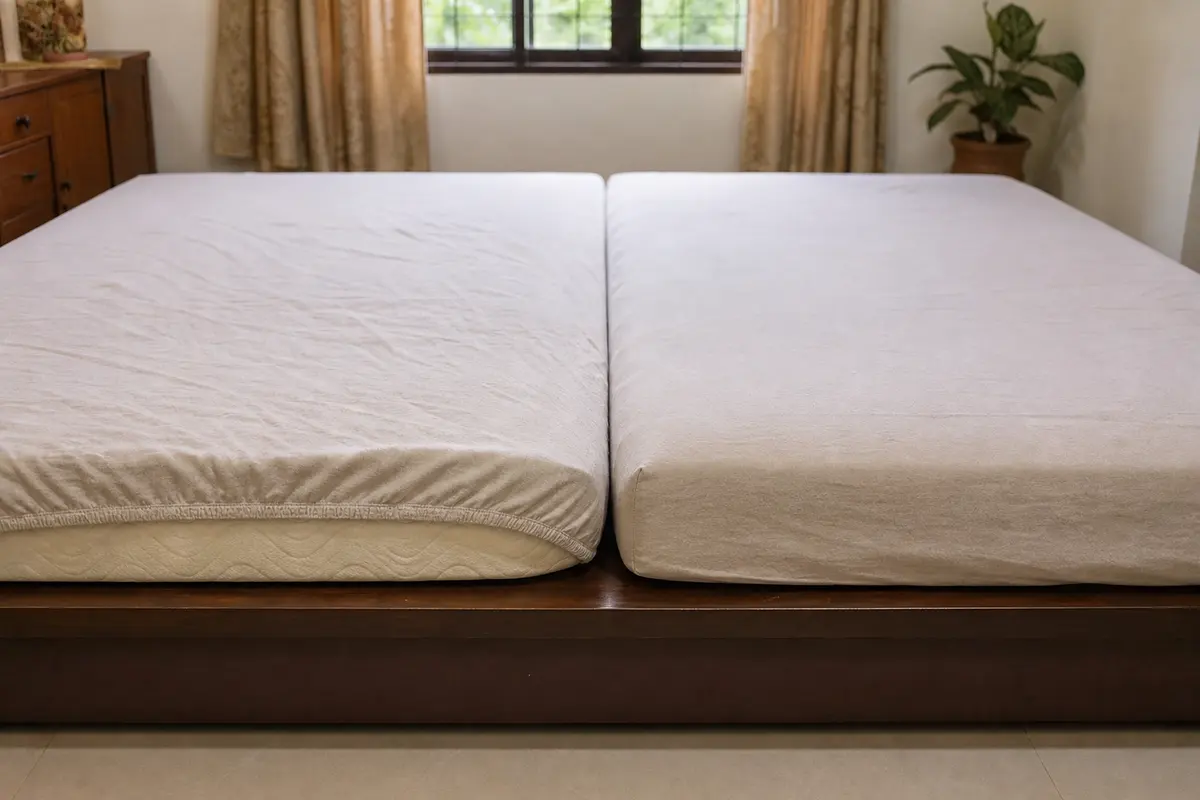
A fitted bedsheet has elastic at the corners or around the edge and is pulled over the mattress so that it grips it. A flat sheet is a plain rectangle that you spread and tuck in by hand. The fitted sheet stays in place better. The flat sheet is easier to fold and can be used on more than one mattress size.
Why does my fitted sheet keep slipping off?+−
Most often the mattress is taller than the sheet allows. Measure the mattress height, including any topper, and compare it with the depth given for the sheet. Other common reasons are a sheet made for a different length or width, elastic that has become loose with age, or elastic only at the corners.
How do I know what size fitted sheet to buy?+−
Measure three things on your mattress: length, width and height. The length and width of the sheet should match the mattress closely. The height of the mattress should be within the depth the sheet can cover. Do not go only by names like queen or king, because these differ between makers.
Can I use a fitted sheet on any mattress?+−
Only if the mattress matches the size and height the sheet is made for. A fitted sheet that is too small will not go on or will pull off at the corners. One that is too big will be loose and wrinkled. If your mattress is an unusual size, a flat bedsheet is often the easier choice.
How do you put on a fitted bedsheet easily?+−
Start at one top corner and pull the pocket fully down over the mattress corner. Do the other top corner next, then the two bottom corners. Lifting the mattress corner slightly helps on a tight fit. Finally, smooth the sheet from the middle outwards and push the elastic under the mattress edge.
How do you fold a fitted bedsheet?+−
Hold the sheet inside out with a hand in each of two corners along one short side. Bring your hands together and tuck one corner into the other. Do the same with the other two corners, then tuck one pair into the other pair. Lay it flat, straighten the edges into a rectangle and fold as usual.
Do I need a flat sheet on top of a fitted sheet?+−
It is your choice. Some people sleep directly between a fitted sheet below and a dohar, quilt or comforter above. Others place a flat sheet in between as a top sheet, so that the heavier cover needs washing less often. In hot weather the top sheet alone can also serve as a light cover.
Does the elastic in a fitted sheet wear out?+−
Elastic can slowly lose its stretch with age, repeated washing, very hot water and strong sun. How long it lasts depends on the quality of the elastic and how the sheet is cared for. Following the care label and drying the sheet in shade can help it keep its grip for longer.