Which bedsheet for kids suits each age, from toddler to teenager?
The right bedsheet changes as a child grows: toddlers need sheets that stay put and wash easily, school-age children need sturdy sheets they can manage themselves, and teenagers need adult sizes in designs they choose.
For a small child who has moved to an own bed, the sheet should sit flat and tight, with no loose folds. Expect spills and night-time accidents, so easy washing comes first. This guide is about children in their own beds. For babies and cradles, follow your doctor's advice.
From about school age, children eat, read, draw and play on the bed. A firm, closely woven sheet handles this rough use better than a very fine, delicate one. This is also the age to let them help make the bed.
Teenagers are often as tall as adults. Check that the mattress and sheet length still suit their height, and move to a full single or larger. Let them pick the colour. A sheet they like is a sheet they will look after.
What bedding does a bunk bed need?
A bunk bed needs sheets matched to its own mattress size, which is often narrower and thinner than a regular single, and bedding that is easy to put on in a tight space. Measure each bunk, as the two are not always the same.
Making the top bunk is the hard part. You cannot walk around it, and lifting the mattress to tuck a sheet is awkward. A fitted sheet of the right size is a real help here, since it only has to be hooked over four corners. If you use a flat sheet, choose one that is not much larger than needed, so there is less to tuck.
Bunk mattresses are commonly thin. A sheet with deep pockets made for a thick mattress will sit loose on them. Check the depth in the product's details.
Keep covers neat. A cover that hangs far down from the top bunk gets pulled by the child below and can get in the way on the ladder. A light cover close to the mattress size is easier for the child to handle.
How can I protect a child's mattress from spills and bed-wetting?
Use a waterproof mattress protector under the bedsheet, so that a spill or a wet night means washing a sheet and a protector, not trying to dry a mattress. A mattress that gets soaked takes days to dry and may keep a smell.
A mattress protector is a thin, fitted layer that goes over the mattress first. The bedsheet goes on top as usual. Choose a washable one with a fabric surface, so it does not feel or sound like plastic under the sheet. Check the product's details for size and care.
Keep two protectors if you can. Then a clean one is ready at night while the other is washed. Some parents make the bed in double layers, protector and sheet, then a second protector and sheet on top. At night, the wet top pair is simply pulled off and the dry pair is already in place.
Treat it calmly in front of the child. Rinse wet bedding soon and wash it as the care label says. Our stain guide has more detail.
Which colours and prints work for a kids bedsheet over the years?
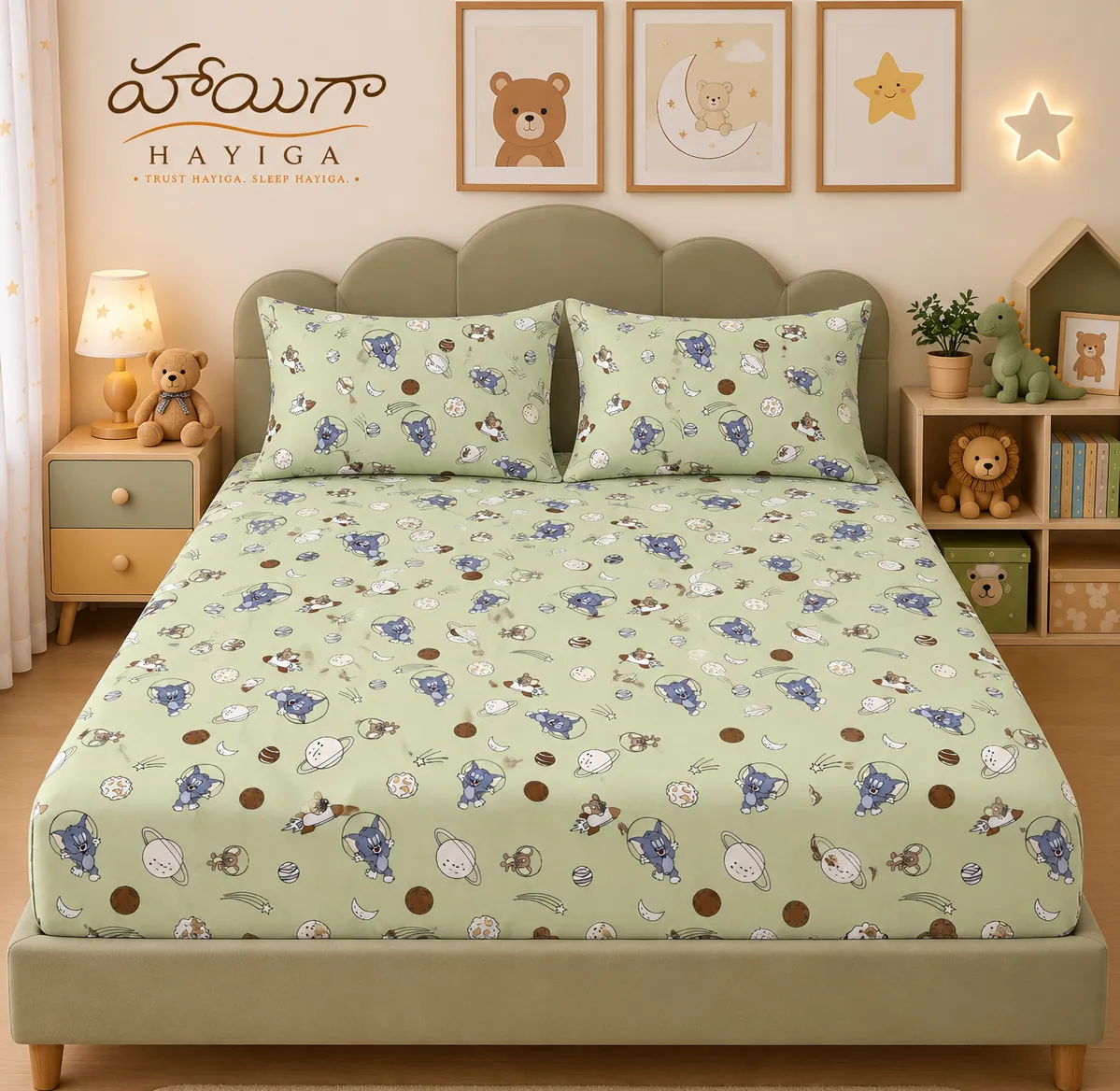
Prints with medium-toned, mixed colours last longest in a child's room, since they hide stains and still look right when the child is a few years older. A favourite cartoon print brings joy now but may be outgrown quickly.
A simple approach is to buy both kinds. Keep one set in a design the child is excited about today, and one or two sets in patterns with a longer life, such as stripes, checks, stars, animals or simple shapes. When the favourite is in the wash, the bed still looks cheerful.
Think about stains honestly. Very pale, plain sheets show ink, juice and food marks at once. Busy prints in medium shades are forgiving. Very dark plain sheets show lint and fade lines.
If siblings share a room, sheets in the same pattern but different colours give each child an own look while keeping the room tidy. Involve the child in the final choice between two or three options you are already happy with. Children tend to take better care of what they picked.
What cover suits a child who kicks off the blanket at night?
For a child who kicks off covers, choose one light cover that is a little larger than the mattress and stays in place, instead of a heavy one. Children often kick because they feel too warm or the cover feels heavy.
Check warmth first. If the child's cover is as thick as yours, it may simply be too much. A dohar or a thin quilt is usually enough in most Indian weather, and the room fan or AC can be adjusted a little instead of adding layers.
Size helps. A cover that is only as big as the child ends up on the floor by midnight. One with some overhang, tucked lightly under the mattress at the foot end, stays on the bed even when the child turns. Leave the sides free so the child can move.
On cold nights, warm night clothes with full sleeves do the job that the lost blanket cannot. Then it matters much less whether the cover stays on until morning.
How should bedding be planned when siblings share a bed or a room?
When two children share a bed, give them one well-fitting sheet and two separate covers, so that one child's turning does not leave the other uncovered. One shared cover is the usual cause of midnight quarrels.
A shared bed is normally a double or queen, so buy sheets by that mattress's measurements, not as kids' sizes. Each child gets an own pillow and an own light cover in single size. Different colours make it clear whose is whose.
When children share a room in separate beds of the same size, keep all the sheets interchangeable. Any clean sheet can then go on either bed, which makes washing day simpler and means fewer sets in total.
Children of different ages may feel the cold differently and go to bed at different times. Separate covers handle both. The older child can have a slightly warmer layer without the younger one feeling too warm.
Give each child a fixed shelf or basket for their own bedding. It builds the habit of folding and putting away.