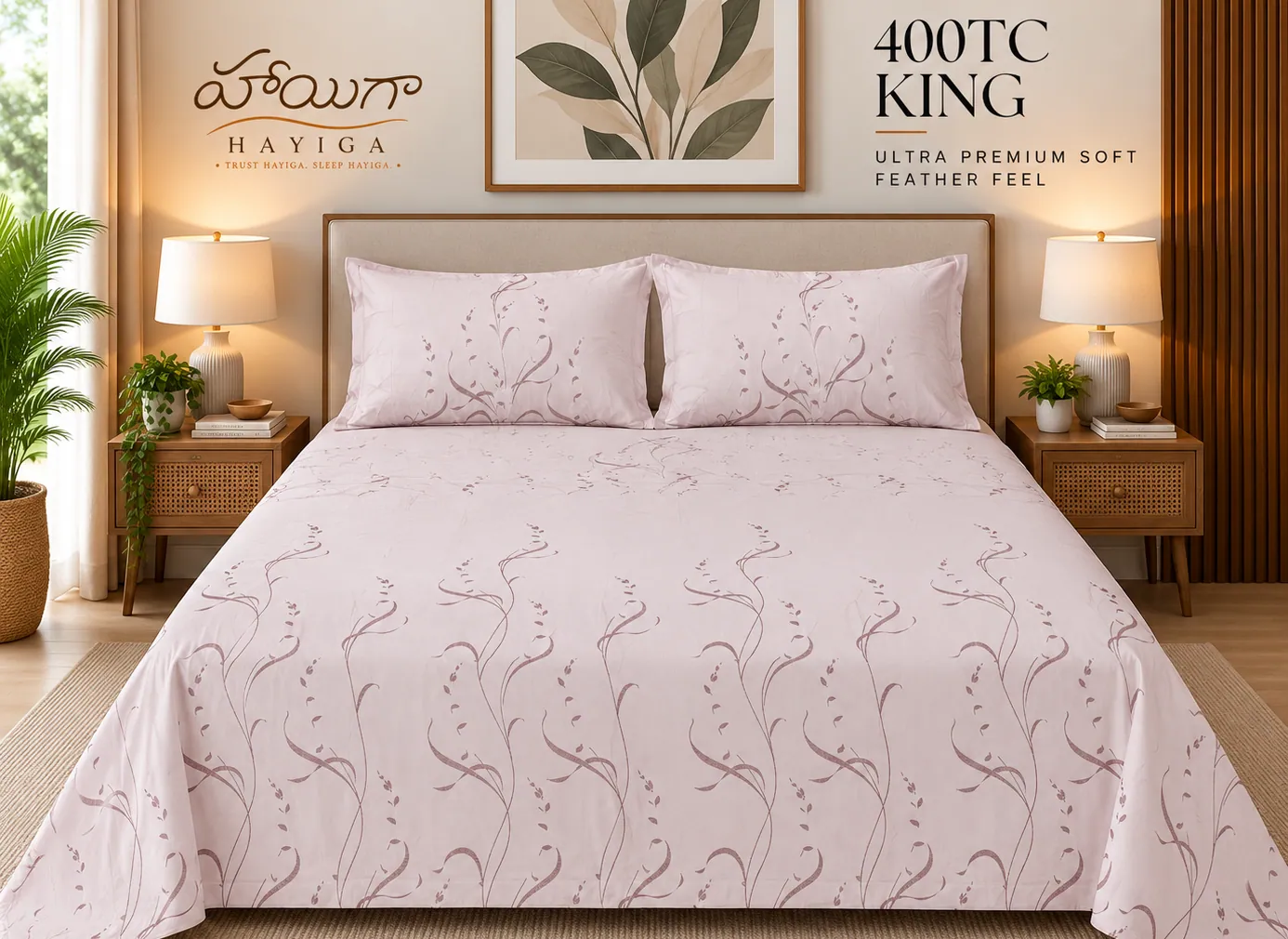
What does TC mean on a bedsheet, as in 144 TC or 300 TC?
TC is the short form of thread count, so 144 TC means about 144 threads in one square inch of the cloth, and 300 TC means about 300. The number counts the threads running along the length and across the width, added together.
A lower number means the threads are thicker or more widely spaced. Such cloth is usually lighter and more open, and air passes through it easily. A higher number means finer threads packed closer together. Such cloth usually feels smoother and more dense.
Neither is right or wrong. Light, open cotton has been used in Indian homes for generations because it suits heat. Denser cloth gives a smoother surface that many people enjoy.
When you see TC on a label, treat it as one line of information. Read it along with the fabric composition and the weave. If the listing does not state a thread count, do not assume one. Check the product's details or ask the seller.
Is 300 thread count good for bedsheets?
Yes, 300 thread count is generally considered a good, comfortable count for a cotton bedsheet, as long as the cotton itself is of good quality. At this level the cloth is usually smooth and closely woven without being heavy.
But the number alone cannot promise anything. A 300 thread count sheet made from good, fine cotton yarn can feel far nicer than a sheet with a bigger number made from weaker yarn. The fibre and the weave decide the feel as much as the count does.
Also think about your weather and your habits. A denser sheet holds a little more warmth and takes a little longer to dry than a light, open one. In a very hot room with no AC, some people prefer a lighter cloth. In an AC room, many like the smoother, fuller feel.
So ask what the sheet is made of, how it is woven and how you sleep. The count is useful only after those answers.
Does a higher thread count make a bedsheet softer?
A higher thread count can make a bedsheet feel smoother, but it does not make it softer by itself. Softness comes mainly from the quality of the fibre, the fineness of the yarn, the weave and the finishing.
Finer yarns are needed to fit more threads into a square inch, and fine yarns from good cotton do feel smooth. That is the true part of the idea. But when a high number is reached by packing in more threads of ordinary yarn, the cloth can turn stiff and heavy instead of soft.
The weave changes the feel as well. A sateen weave feels silky at the same count where a percale weave feels crisp. Washing matters too. Most cotton sheets soften with use as the mill finish washes out.
If softness is what you want, touch the cloth where you can. Online, read the fibre and weave details and what buyers say about the feel after washing. Do not choose on the number alone.
Single-ply and multi-ply yarn: how do they change thread count?
Single-ply yarn is one strand, and multi-ply yarn is two or more strands twisted together into one thread. The difference matters because some thread counts are reached by counting each strand of a multi-ply thread separately.
Here is how that works. Suppose a cloth has a certain number of threads in a square inch, and each thread is made of two strands. If every strand is counted, the number on the label doubles, though the cloth itself has not changed. This is one reason very large thread counts appear in the market.
Multi-ply yarn is not bad in itself. It can make a strong, heavier cloth. It simply should not be read as if it were a finer weave.
Fine single-ply yarn made from good cotton generally gives a light, smooth and breathable sheet. If a listing mentions the ply, that is helpful. If it gives only a very big number and nothing else, compare it carefully with other details such as the fibre and the weave.
Does thread count affect how long a bedsheet lasts?
Thread count affects durability only a little; how long a bedsheet lasts depends more on the strength of the fibre and yarn, the weave and the way it is washed. A higher count is not a promise of a longer life.
A very loose, low-count cloth made from weak yarn can wear thin early. A reasonably close weave holds together better, so there is some benefit in a moderate count. Beyond that, extra threads do not keep adding strength. Extremely fine threads packed very tightly can even be more delicate.
Care makes the biggest difference at home. Harsh detergent, very hot water, strong sun every day and an overloaded machine shorten the life of any sheet, whatever its count. Gentle washing and drying in shade lengthen it.
Rotation helps too. A sheet used every other week lasts longer than one used and washed without a break.
So for a long-lasting sheet, look for good cotton and neat construction, and follow the care label on the product.
Can you check the thread count of a bedsheet at home?
You cannot measure thread count accurately at home, because the threads are too fine to count without a magnifying tool made for the purpose. What you can do is judge the cloth by simple checks.
Hold the sheet up to a window or a light. A closely woven cloth lets through less light and shows an even surface. If you see uneven thin patches, the weave is not regular. Feel the cloth between your fingers. A dense weave feels smooth and firm, while a loose weave feels lighter and more open.
These checks tell you about the cloth, not the exact number. Fabric laboratories count threads under magnification using a set method, which is how a stated count should be arrived at.
So rely on what the seller declares, and see whether it fits with the rest of the details, such as the fibre, the weave and the weight. If a number seems too big for a light, thin cloth, ask the seller how it was counted.
Does thread count matter for dohars, quilts and comforters?
Thread count matters much less for dohars, quilts and comforters than it does for bedsheets. In these covers, comfort comes mostly from the layers or the filling and from how they are stitched.
A bedsheet is a single layer that lies directly against your skin all night, so the fineness of its weave is easy to feel. A dohar is made of several light layers. A quilt or comforter has filling inside. Their warmth and weight depend on what is inside and how much of it there is.
The outer fabric still counts for something. A closely woven outer cloth feels smoother, and in a filled cover it also helps keep the filling from working its way out. But you do not need to hunt for a big number.
Many listings for these products do not state a thread count at all, and that is normal. Read the fabric of the outer layer, the filling or the number of layers, and the care instructions. Check the product's details for these.